
Legislative changes that will affect your business: CBAM, renewable energy, cybersecurity, and more.

2.12.2025
Both European and Czech legislation in the fields of environmental protection and energy are undergoing fundamental changes that have a direct impact on companies’ strategy, operations, and reputation. The third quarter of 2025 brought several key updates – and you will find these in our latest ESG, environmental, and energy legislation monitoring, which we prepare in detail for our clients three times a year. Below you will find a brief summary and a downloadable sample.

CBAM: The carbon border tax is heading into practice

Starting in January 2026, the CBAM (Carbon Border Adjustment Mechanism) system will become fully operational, introducing a carbon tax on selected types of goods imported into the EU. Larger importers will be required to obtain the status of an authorized declarant. At the same time, the European Commission has simplified the administrative process and narrowed the group of companies to which CBAM applies. In the next quarter, rules for calculating embedded emissions and an extension of CBAM to additional commodities are expected to be issued.

News in the field of carbon and wood

The Commission has presented a draft regulation introducing certification for three types of carbon removal – including biochar production. In the Czech Republic, an amendment to the Act on the Placing of Timber on the Market has been approved, responding to the European regulation against deforestation.

Energy sector: Faster permitting of renewable energy sources and unlocking grid capacity

From August 2025, permitting processes for renewable energy sources will accelerate significantly thanks to the amendment known as the ‘lex gas’. During 2026, we also expect the introduction of acceleration zones under the new Renewable Energy Acceleration Act. Companies should anticipate pressure to release unused reserved grid capacity — by November 2026, holders must sign an amendment to their contract with the distributor, otherwise the reservation will expire. At the same time, it will be possible to use the newly released available grid capacity. Additionally, as of October, the economics of battery storage systems have improved thanks to the removal of double charging.

Cybersecurity: New Obligations for the Energy Sector

From November 2025, a new Cybersecurity Act implementing the NIS 2 Directive will enter into force. It expands obligations to 18 sectors, including energy. We recommend verifying whether the new requirements also apply to your company – and preparing for changes in risk management, incident reporting, and management accountability.

Monitoring that saves you time, money, and reputation

Monitoring changes in environmental and energy legislation is becoming an increasing challenge for companies. According to surveys, more than 70% of large companies cite legislation as one of the biggest obstacles to meeting their ESG goals. Penalties for non-compliance can reach millions.
At Frank Bold, we provide our partners with exclusive legislative monitoring that helps you stay one step ahead:
  • Three times a year, a detailed overview of changes in environmental, energy, and ESG legislation.
  • Impact analysis for your business – what the new regulations specifically mean for you.
  • Expert consultations – we help with both implementation and communication of changes.
  • Personal presentations of findings – clear, comprehensible, and practical.
Learn more about our service
Thanks to our Brussels representation and participation in expert bodies of the European Commission and EFRAG, you receive information directly from the source – earlier than others.
Download a free sample
Domluvte si u nás konzultaci Book a consultation

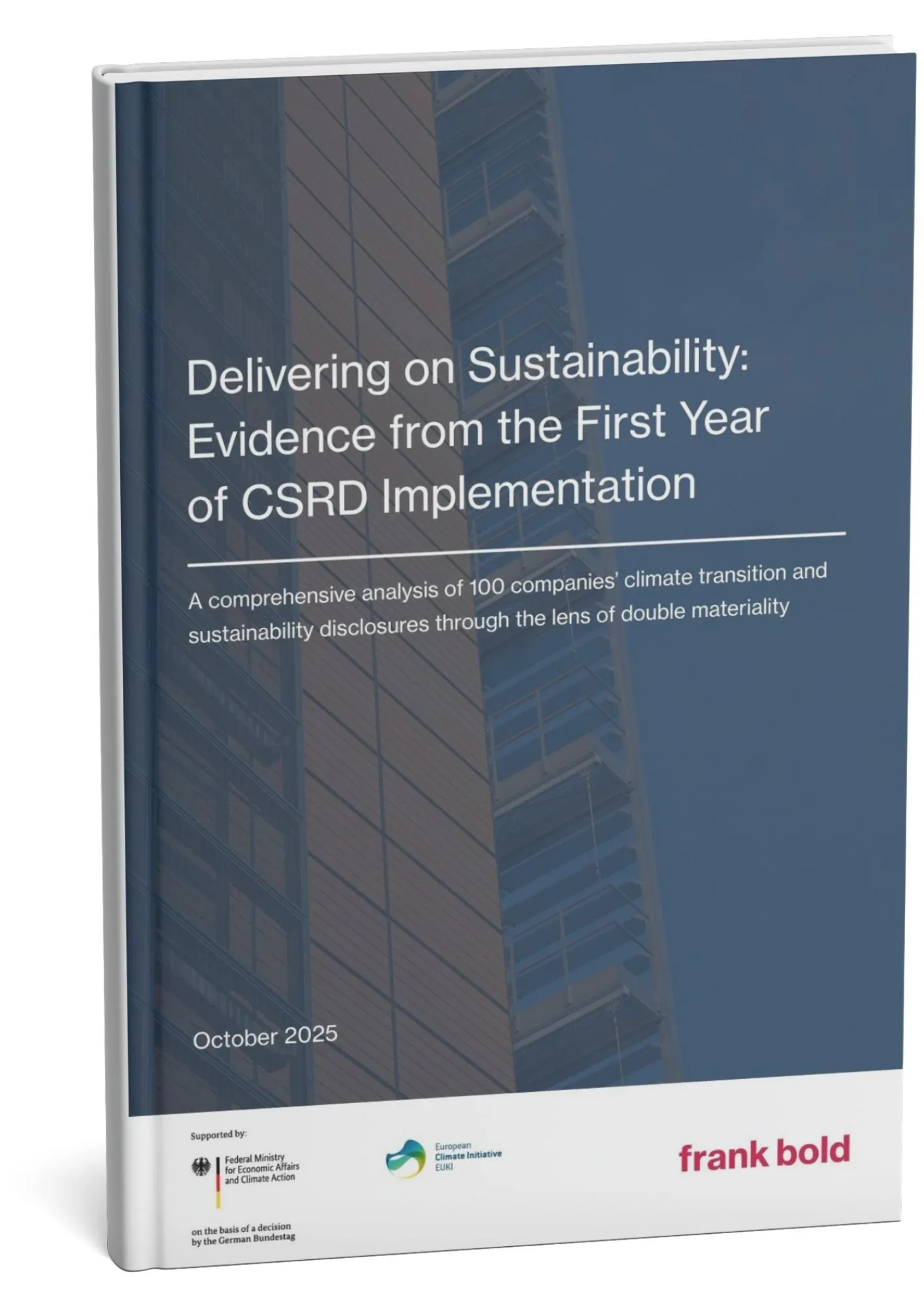
ESG report analysis of 100 European companies

Discover how European companies are managing ESG reporting. The new study by Frank Bold’s Responsible Companies team summarizes the first wave of sustainability reports from one hundred major European companies and shows that reporting under the CSRD provides valuable data for decision-making and is becoming an effective tool for risk management. Publication is part of the European Climate Initiative (EUKI) of the German Federal Ministry for Economic Affairs and Climate Action (BMWK).

ESG Reporting and Carbon Footprint

Leverage practical experience and legislative expertise of our international team.

ESG report according to ESRS standard

Comprehensive Sustainability Report aligned with CSRD.

CSRD reporting light

A simplified ESG report for your business partners.

Product carbon footprint calculation

Mapped according to GHG Protocol Product Standard.

All services

We are part of the Frank Bold Expert Group

Become a member of the ESG Club