
At first glance, this change may appear to be a relaxation of regulation. In reality, however, it introduces a new type of uncertainty—while also creating opportunities for companies that want to manage risks strategically and strengthen their position in the market.
One of the most significant changes is the reduction in the number of companies directly subject to the CSDDD. The new thresholds of 5,000 employees and a turnover of €1.5 billion reduce the scope of regulation by approximately 70%. However, this does not mean that other companies fall outside the regulatory framework. On the contrary, it can be expected that large companies will pass their requirements on to suppliers, while pressure from investors, banks, and customers will continue to increase. Moreover, a significant portion of high-risk sectors, such as the textile industry, construction, and mining, remains under heightened scrutiny. In practice, ESG requirements are therefore spreading across value chains regardless of whether the legislation applies directly to a specific company.
The revision also preserves the principle of a risk-based approach, meaning that companies must continue to systematically identify adverse impacts on human rights and the environment, prevent them, mitigate them, and actively address them within their operations as well as their business relationships. In this context, well-designed due diligence proves to be one of the most effective risk management tools. It helps protect a company’s reputation, reduce legal exposure, and strengthen the trust of key stakeholders. A reduction in regulation therefore does not in fact mean less responsibility, but rather a greater emphasis on strategic and well-considered ESG management.

The changes also affect the area of climate transition plans. Although these were removed from the CSDDD, the obligation to disclose them remains under the CSRD directive. For companies, this means the need to ensure a consistent and credible ESG approach across different regulatory frameworks. The ESG agenda is therefore not becoming simpler, but rather more interconnected and complex.
A significant change is also the removal of a unified framework for civil liability at the EU level. In practice, this means that rules will vary across individual Member States, leading to a higher degree of legal uncertainty. Access to remedies for affected parties will become less predictable, and companies will need to more carefully assess the risks associated with cross-border business activities. Paradoxically, less harmonized regulation may thus result in greater complexity and increased risks.
Despite these changes, the CSDDD remains one of the most significant regulatory frameworks of the European Union. Companies that take a proactive approach to ESG can gain a substantial competitive advantage, strengthen their position within supply chains, and better prepare for future legislative developments, including the planned review in 2031. Conversely, underestimating ESG can lead not only to reputational damage, but also to the loss of business opportunities and increased legal risk.
.webp)
This article is based on the legal analysis “Sustainability Due Diligence after the Omnibus: Legal Implications for the CSDDD” jointly published by the organizations ClientEarth and Frank Bold. The analysis examines in detail the impacts of the Omnibus I revision on the CSDDD and provides practical guidance on how to navigate the new regulatory environment.
At Frank Bold Advisory, we help you navigate the current requirements of the European CSRD directive as well as the ongoing changes brought by the so-called Omnibus regulation. We guide you through the preparation of an effective ESG report in line with ESRS standards – whether you're just starting out or looking to improve existing processes. We work with both major market players and smaller companies within supply chains – from initial analysis and selection of key indicators to final reporting.
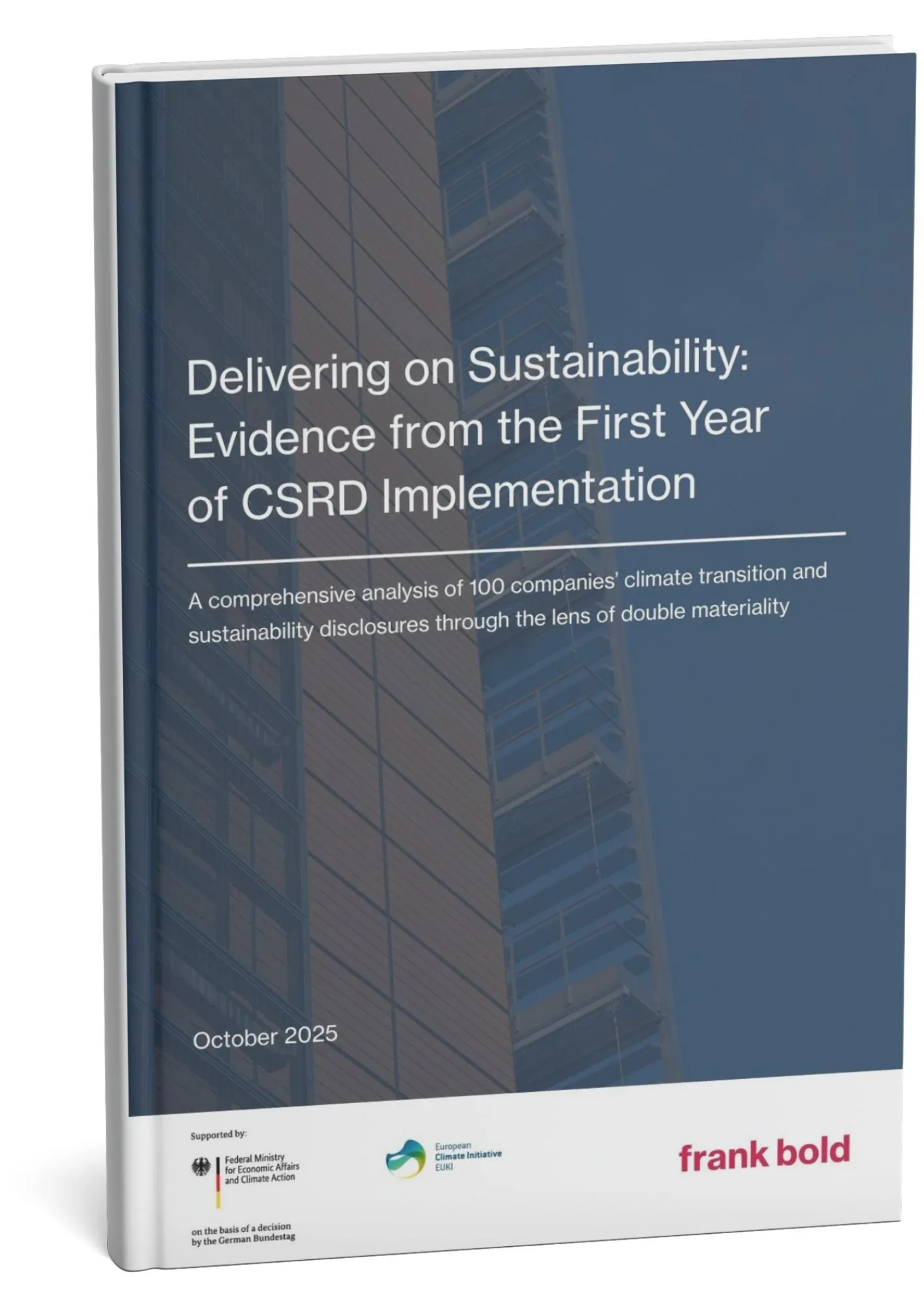
Discover how European companies are managing ESG reporting. The new study by Frank Bold’s Responsible Companies team summarizes the first wave of sustainability reports from one hundred major European companies and shows that reporting under the CSRD provides valuable data for decision-making and is becoming an effective tool for risk management. Publication is part of the European Climate Initiative (EUKI) of the German Federal Ministry for Economic Affairs and Climate Action (BMWK).

Comprehensive Sustainability Report aligned with CSRD.
.webp)
A simplified ESG report for your business partners.

Mapped according to GHG Protocol Product Standard.
We are part of the Frank Bold Expert Group
Copyright ©
Aktuální rok script
Frank Bold