
The European Commission has adopted the revised EuropeanSustainability Reporting Standards (ESRS) as a delegated regulation. This isthe final and binding version of the standards – during thelegislative process over the next two months, the European Parliament and theCouncil can only reject them as a whole, not amend them. And the likelihood of rejection is very low. Companies thus have a clearframework to prepare for.
· Starting in 2026, companies in the first wave may voluntarily adopt therevised ESRS .
· Starting in 2027, the standards will be mandatoryfor all companies within the scope of the CSRD (companies with more than1,000 employees and revenue of 450 million EUR).
· A separate version of thestandards (ESRS-TC) is being developed for groups with a parent companyoutside the EU.
The standards explicitly enshrine the principle of fairpresentation. The sustainability report should be shorter and moresubstantive—focused on truly significant impacts and risks, rather than onmechanically filling out forms. Companies should also adapt their internal datacollection processes accordingly.
Companies continue to report, within a single integratedframework, both the impacts of their activities on the environment and peopleand the financial risks and opportunities arising from significant impacts or dependencies. Disclosure requirements are not dividedinto two separate sections—this simplifies the report’s structure and maintainsclarity for investors.
The standards retain the requirement to quantify the expectedfinancial effects of sustainability-related risks and opportunities. However,the Commission has extended the transition period for these disclosures byanother year—the requirement will not take effect until 2031. Companieshave time to gradually develop their methodology, but we recommend startingwith a qualitative description and internal quantification estimates as soon aspossible.
Companies can now choose for themselves which approach touse when defining organizational boundaries for calculating greenhouse gasemissions—they can choose between financial control, operational control, orequity interest. However, this weakens the principles designed to prevent themanipulation of boundaries to reduce reported emissions.
The obligation to disclose information on microplasticsapplies only to intentionally manufactured microplastics. Reportingrequirements for secondary microplastics (those resulting from the degradationof plastic products) have been omitted from the standards. Yetthe Commission itself noted that secondary microplastics account for 69–81% ofmicroplastics in the oceans. This decision is all the more difficult to justifygiven that EFRAG proposed only qualitative disclosure, without anycomputational burden on companies.
Companies are not required to report all complaints andongoing cases. Under the new rules, it will suffice to report incidents thatthe company itself assesses as substantiated, or those confirmed by a formalcourt decision.
The standards require comparing employee wages to theliving wage threshold as defined by the International Labor Organization (ILO).Therefore, it is not enough to simply demonstrate compliance with the minimumwage—companies should assess how their wage policy measures up against thisbenchmark.
We will familiarize you withthe revised ESRS standards and help you set up the data collection process and reviseyour dual materiality analysis in light of the clarifications in the revised standards.If your company is subject to CSRD reporting requirements, we will assist you inpreparing a pilot report based on 2026 data in accordance with the revised ESRSstandards.
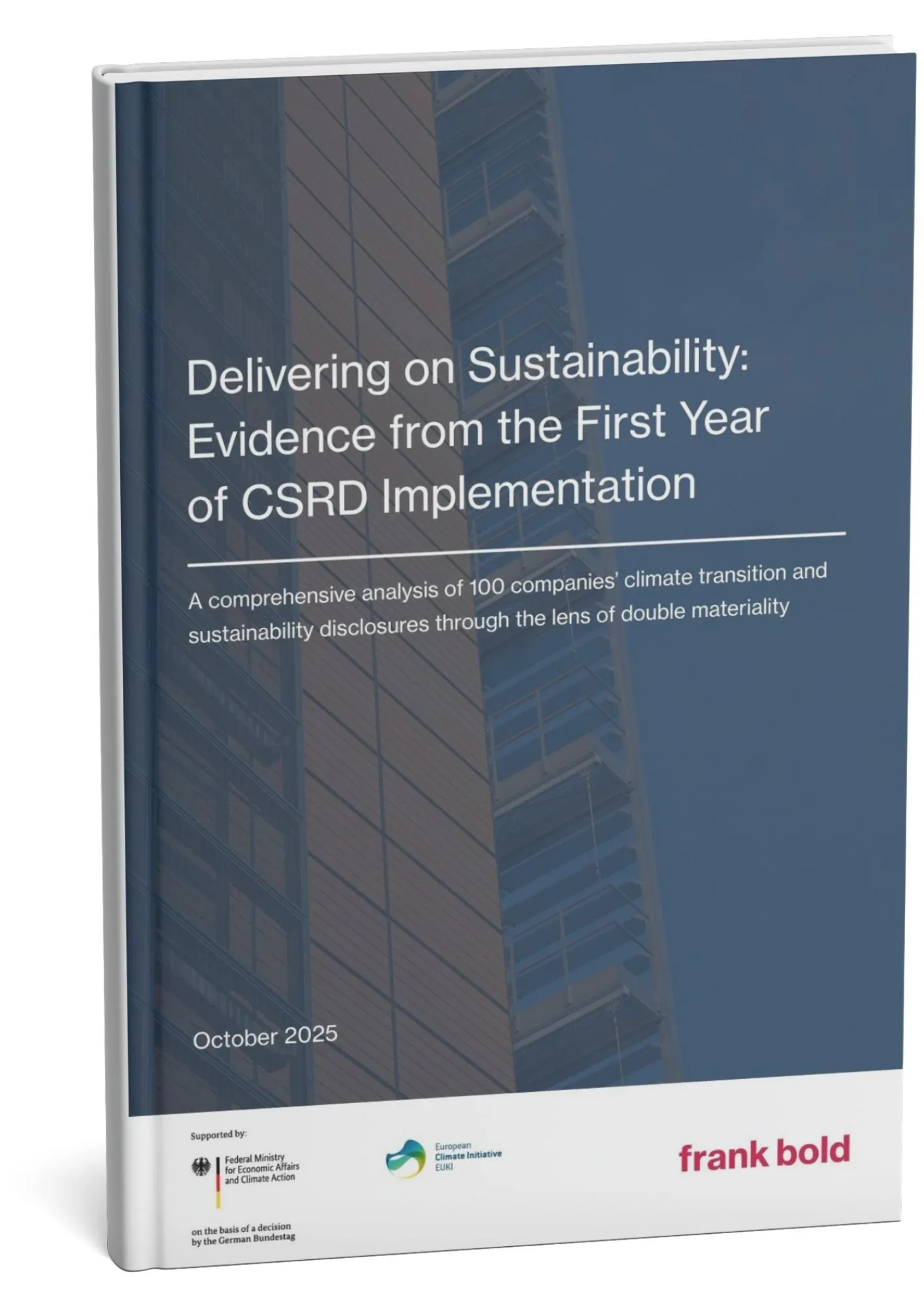
Discover how European companies are managing ESG reporting. The new study by Frank Bold’s Responsible Companies team summarizes the first wave of sustainability reports from one hundred major European companies and shows that reporting under the CSRD provides valuable data for decision-making and is becoming an effective tool for risk management. Publication is part of the European Climate Initiative (EUKI) of the German Federal Ministry for Economic Affairs and Climate Action (BMWK).

Comprehensive Sustainability Report aligned with CSRD.
.webp)
A simplified ESG report for your business partners.

Mapped according to GHG Protocol Product Standard.
We are part of the Frank Bold Expert Group
Copyright ©
Aktuální rok script
Frank Bold